


2026 Update: A Hairy Green Victory
The original troublemaking follows.
I first published this piece on October 30, 2023. I’ve kept the spirit of the original intact—the election references, the smart-ass remarks, and the demand that Columbus give its monster a festival—while adding a few discoveries from digging deeper into the story. This was my pitch, complete with pitchfork.
Now you can read it knowing the hairy green bastard finally got his party.
A huge thank-you to Brooke Hawkins and the Columbus Area Arts Council, the City of Columbus, Columbus Parks and Recreation, Visit Columbus, and the artists, volunteers, and sponsors who brought this hairy green idea to life.
Who has two thumbs and spent three years pestering Columbus to throw a monster festival? This misguided hobgoblin.
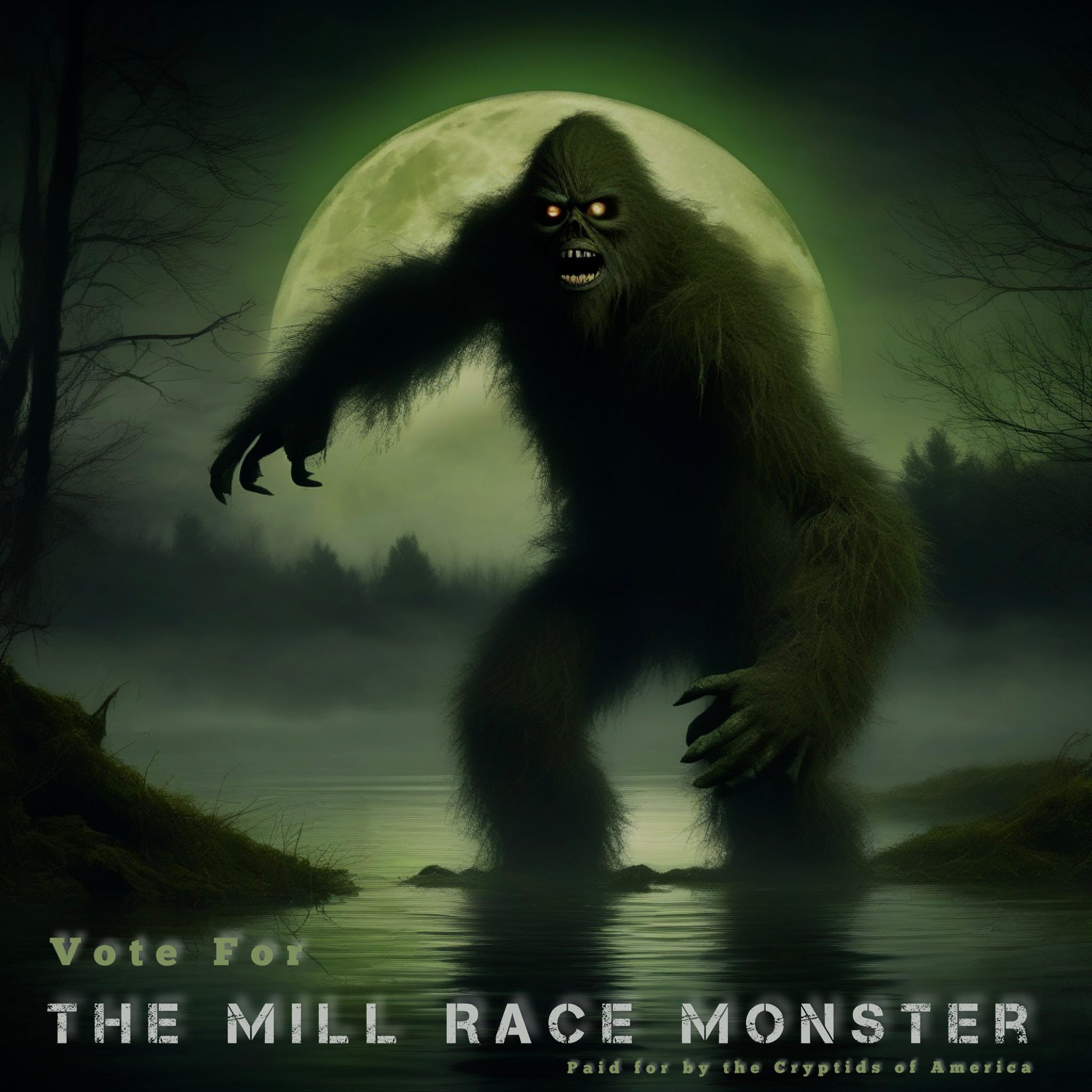
The Mysterious Mill Race Monster
Alright, let’s cut to the chase. Before we understand why a cat-eating, sexy, hairy swamp beast might be the next mayor of Columbus, IN, we must dive into the mysterious world of the Mill Race Monster. Cryptozoology, for those new to the term, is all about hunting for and studying creatures whose existence or survival is up for debate. And a cryptid? Well, that’s an animal that cryptozoologists find particularly intriguing.
The Facts of the Case
Now that we’ve got that settled, let’s take a stroll down the curious path of The Mill Race Monster and cover a few facts:
First things first, it definitely wasn’t me—I was just a 9-month-old at the time.
In the early fall of 1974, near Columbus, Indiana, there were reports of UFO sightings.
Then, things got interesting in November 1974, when reports of a hairy green “monster” brought Columbus to a boil over the course of eight days.
But Columbus, Indiana, didn’t quite seize the monstrous gift—it failed miserably.
The First Sightings
So, let’s dissect this peculiar tale. In the autumn of ’74, in the city of Columbus, Indiana, local UFO sightings were a hot topic. But in November of that year, high strangeness struck when four terrified women made an unusual report to the Columbus Police Department.
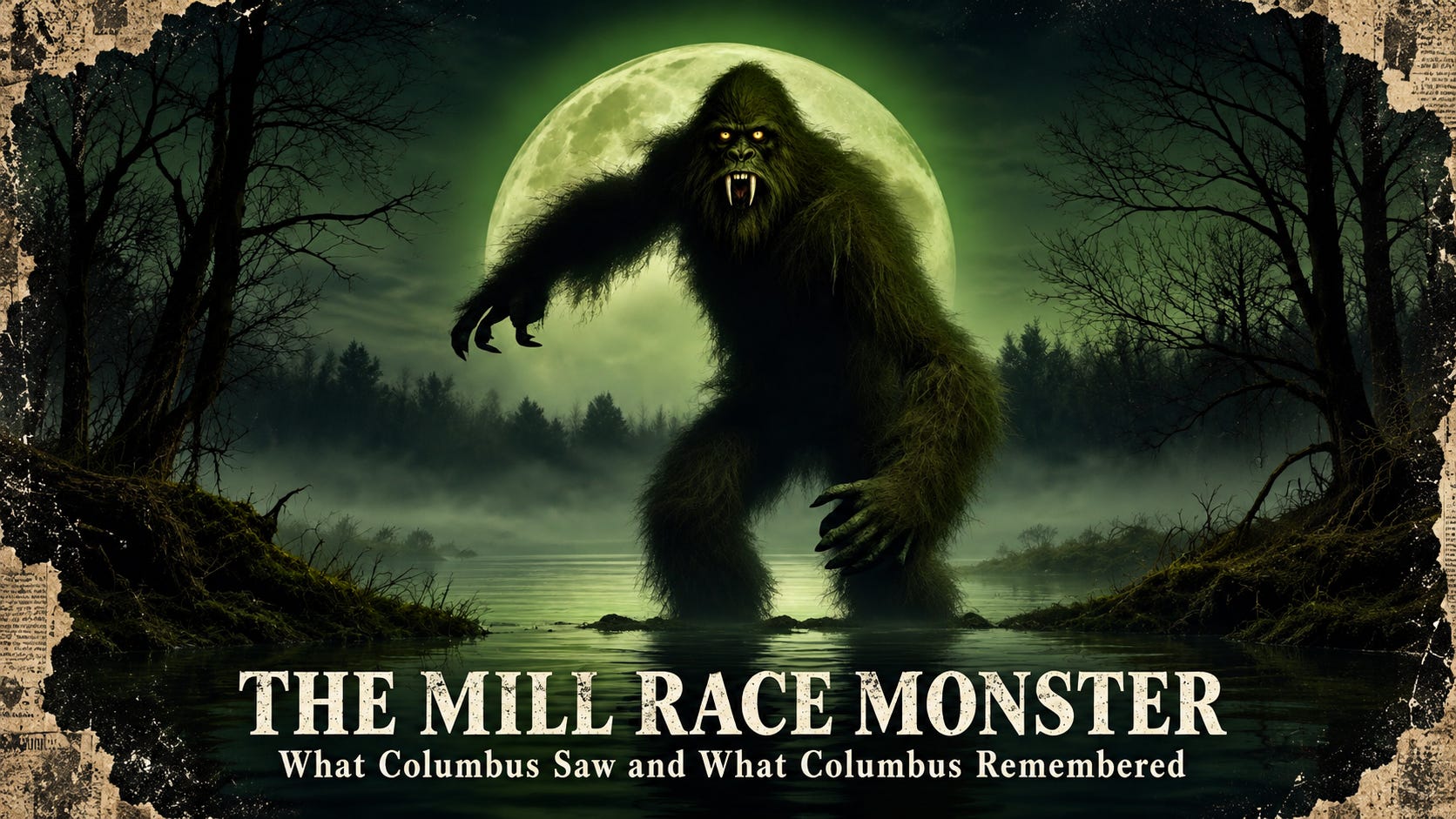
The women stated that they were driving through Mill Race Park—a park off the White River in a wooded area near downtown Columbus. At approximately 3 p.m., in broad daylight, the women parked their car near a boat ramp when they observed “a monster” lurking near the river. They described the creature as 6 feet tall and walking upright on two legs. They also stated that the creature was covered in dark fur and had a pale green face. The police searched the area but found nothing to support the women’s claims.
A Second Encounter
Later that night, around 11:45 p.m., two young women burst into the Columbus Police Department, terrified and shaken. They had their own “monster” encounter in Mill Race Park. As they sat in their car chatting, a hairy creature with a green face leaped onto the hood, trying to break through the windshield with its teeth and long, sharp claws. When the police suggested it might be a prank, the witnesses insisted, “This did not look like a mask.” Even the car had deep scratches on the hood. A second search of the park yielded no monster.
Both encounters happened on November 1, before The Republic’s first story appeared on November 2. That doesn’t rule out a prank, but it does mean the first reports weren’t simply a reaction to a monster they’d already read about in the newspaper. Somebody—or something—had to get the story started.
Media Attention and Further Sightings
The local paper, The Republic, ran a story about these two reports, with the police guessing it might be a “misguided hobgoblin with lousy timing.” But they advised residents to stay alert.
Three days after the story was printed, the monster was spotted again. Two local men visited Mill Race Park around 4 p.m. on Nov. 5. They spotted the creature lurking behind trees near the park’s covered bridge. The two young men gave the same description: a hairy beast that stood upright with a light green face. Despite the warning issued by the police, they decided to return to Mill Race Park that same night armed with a pair of binoculars. The two young men claimed that they were chased out of Mill Race Park by the monster. The men theorized to the police that the creature might have been accidentally left behind by the UFOs spotted in the early fall.
As The Republic continued to report the sightings, people gathered in Mill Race Park, hoping to see the creature themselves. The news of the Mill Race Monster began to spread as The Courier-Journal of Louisville, The Indianapolis Star, and the Chicago Tribune reported the monster sightings.
A Public Frenzy and a City’s Response
A local smart-ass politician even suggested that the monster was a publicity-seeking political candidate trying to begin an early run toward the 1976 election. Hilarious.
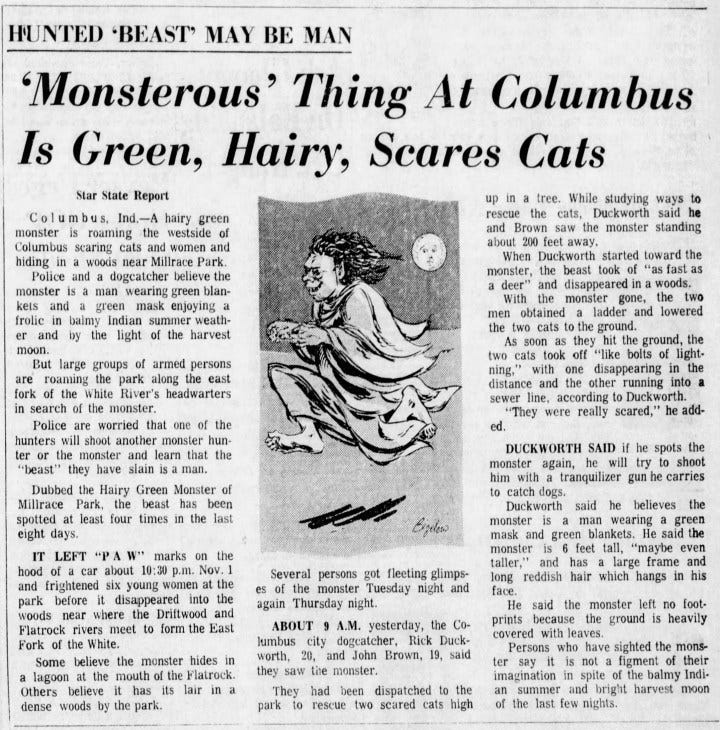
Another sighting came from city dog catcher Rick Duckworth and John Brown, who reported seeing the monster after being dispatched to the park to rescue two cats in a tree. They described the monster as a person wearing a green mask and wrapped in green blankets and spotted about 200 feet away from them. Duckworth said it was 6 feet tall, maybe taller, with a large frame and long reddish hair that hung in its face. But when Duckworth started to approach, it disappeared “as fast as a deer” into nearby woods. After the feline rescue, the cats took off “like bolts of lightning.” According to Duckworth, “They were really scared.” Duckworth said he would plan to shoot the being with a tranquilizer gun he carried for dogs.
But let’s back up to the cats for a second. Who requested the rescue? When were the cats first noticed, and how did that message reach the city? The Indianapolis Star placed the figure about 200 feet away, so somebody could have missed it—or it could have appeared later. I’d still like to know the order of events. The November 8 Republic described Duckworth as being on routine patrol; the November 9 Star described a cat-rescue dispatch. Maybe both accounts fit together. I just want to know how the cat call, the tree, and Hairy Green all ended up in the same scene.
Soon after, the park began to flood with mobs of people, some of whom had traveled miles to hunt for the creature. Many of these folks were armed as the situation devolved into a frenzy.
City officials became concerned for the safety of the public. They felt it necessary to take action before someone got seriously hurt.
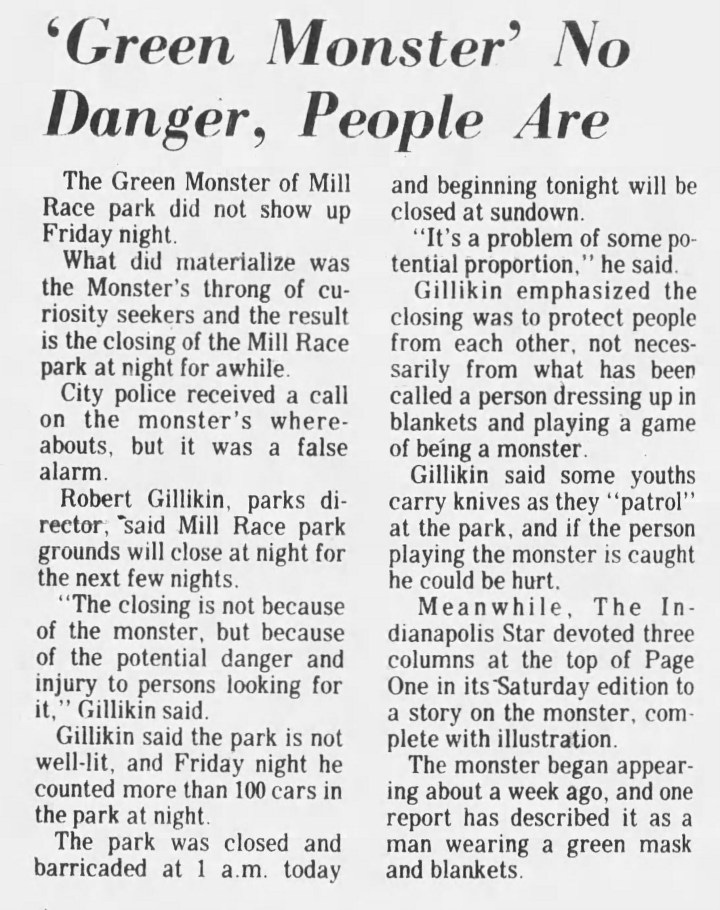
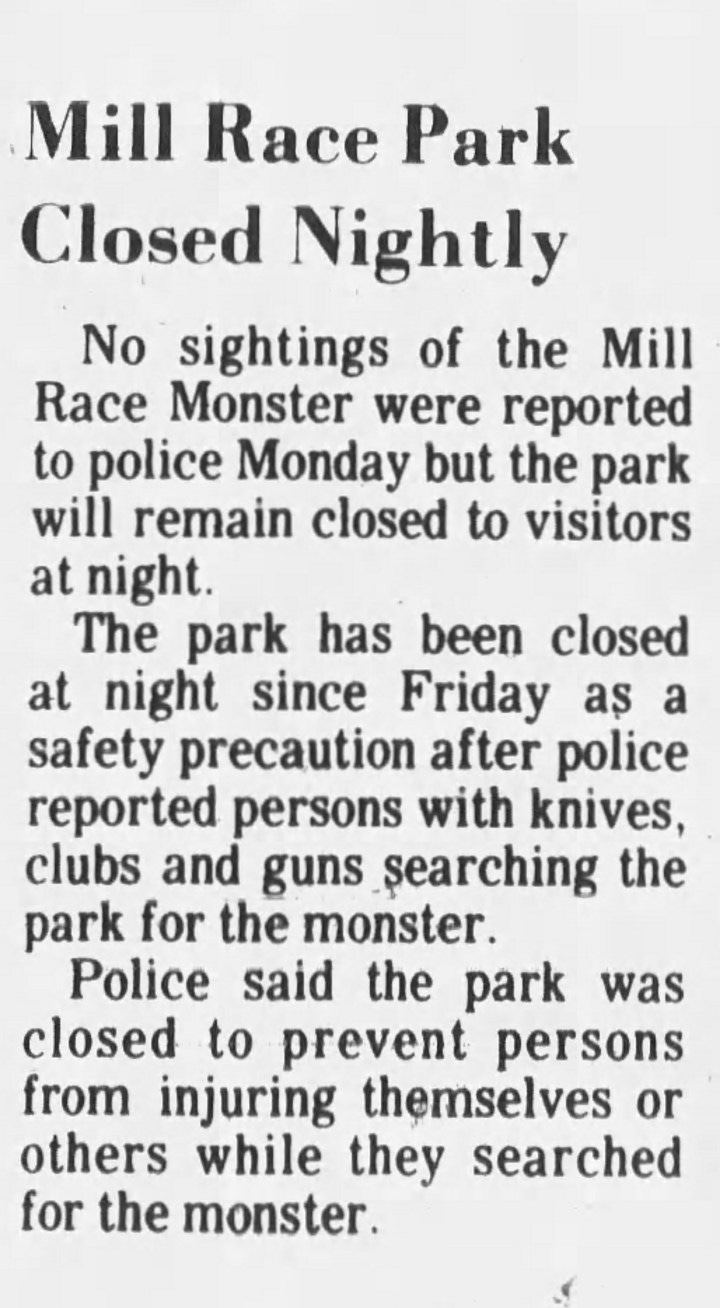
Robert Gillikin, the city park director, found it necessary to close Mill Race Park and deem it off-limits to the public.
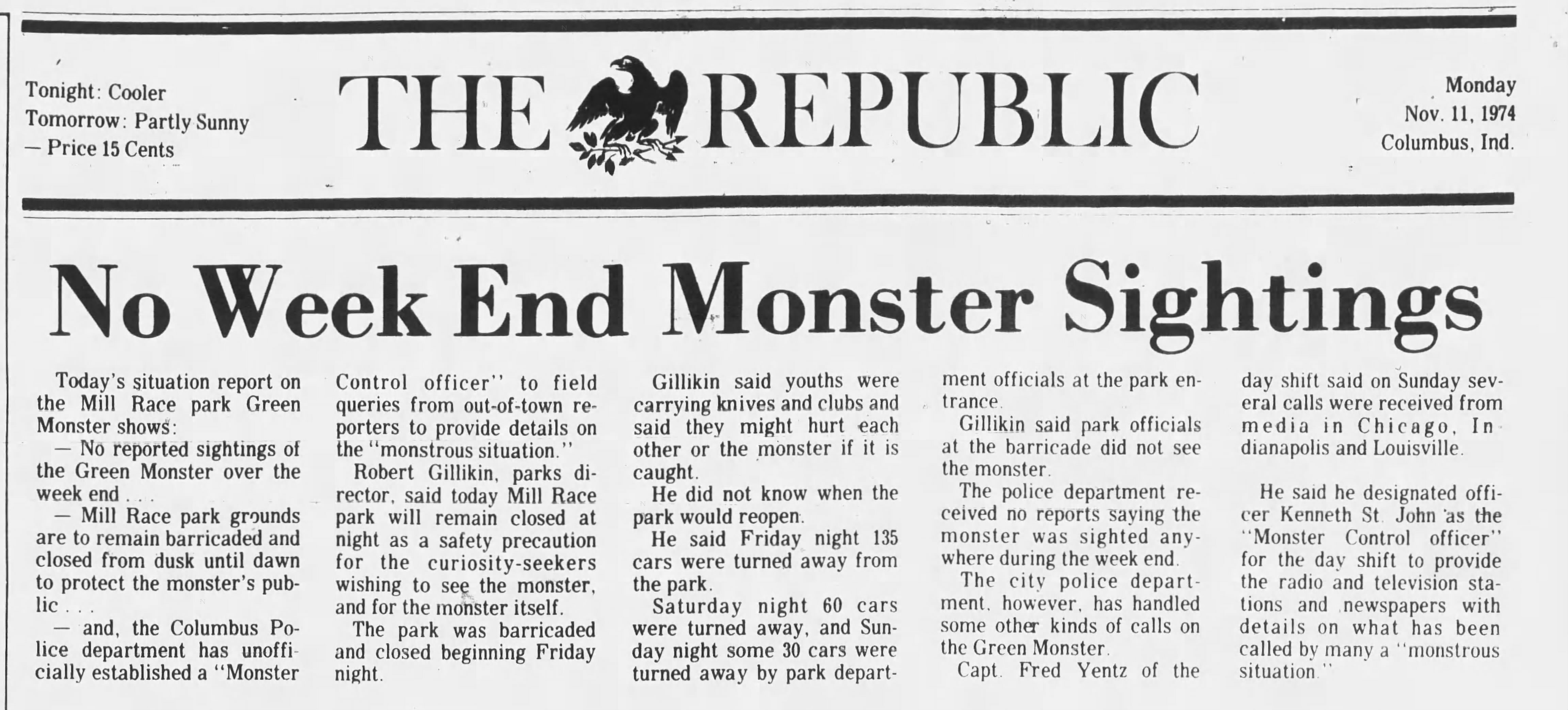
Police Officer Kenneth St. John was appointed “Monster Control Officer” to address the media’s questions and handle reports of the monster. By November 11, The Republic was reporting that the park remained barricaded from dusk to dawn. Police had turned away 135 cars Friday night, 60 Saturday, and about 30 Sunday. Meanwhile, St. John was fielding questions from newspapers, radio stations, and television stations. Hairy Green had gone viral—1974-style, with considerably more telephone wire.
A Mystery Unresolved
The nighttime restrictions continued while officials tried to get the hunters under control. I haven’t found a confirmed reopening date, but as the excitement eventually faded, Mill Race Park returned to ordinary park business—which, presumably, involved fewer armed expeditions for a green hairy thing.
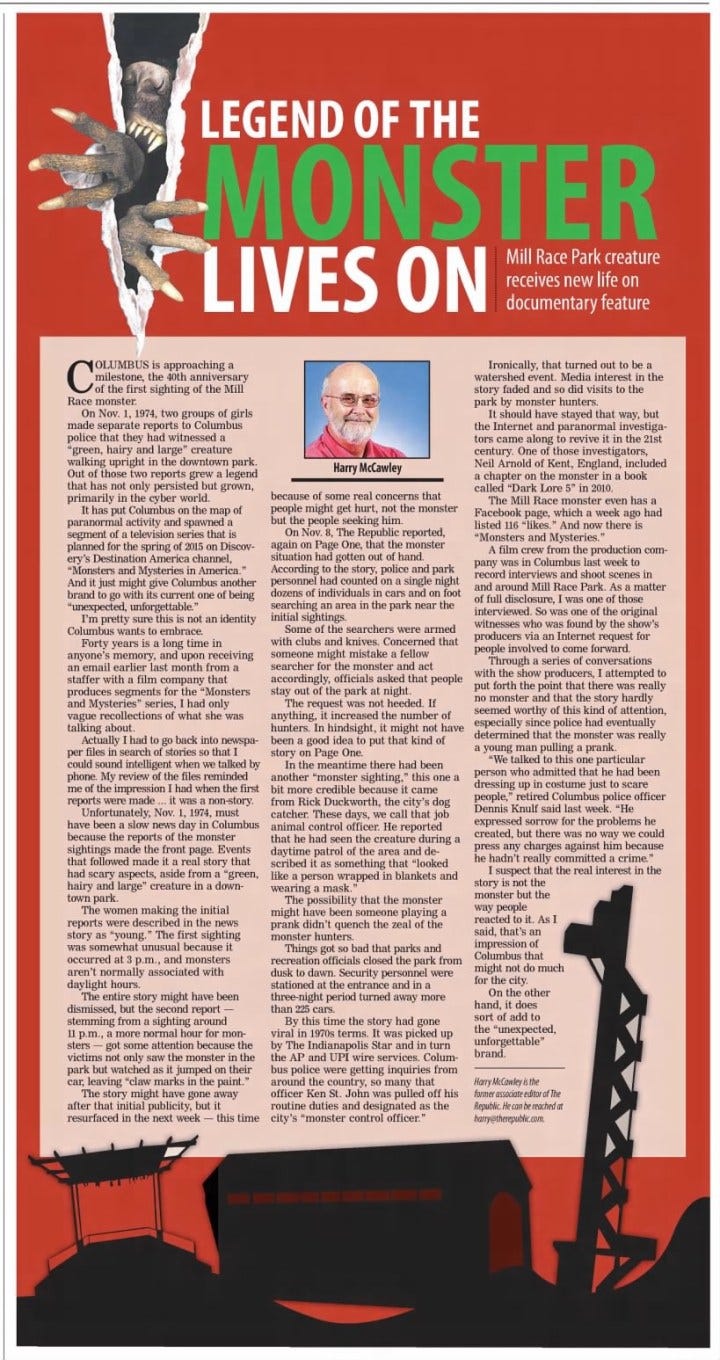
So what happened in Mill Race Park in 1974? Was it a cryptid sighting? An unknown Sasquatch-like creature just trying to live its best life who wound up too close to a community? An exiled extraterrestrial left behind by a UFO? Or, as the late Harry McCawley, an editor at The Republic, suggested in his October 30, 2014, column on the 40th anniversary of the Mill Race Monster, was it a hoax that tarnished Columbus’ reputation and needed to die?
I find it convenient that he left out of Duckworth’s account that he said the monster disappeared “as fast as a deer” into nearby woods—because that’s normal, right? When I’m dressed up like that whilst running (yes, I said whilst running), I can barely make the speed of a possum-trot and still wind up smashed mask first into a tree.
So it looked like a man in a mask, but Duckworth was willing to shoot it with a tranquilizer upon his next sighting of Hairy—that’s logical, right? If Duckworth was so sure he’d seen a man wrapped in blankets, why was his plan for the next encounter an animal-control response? Was he joking? Was he being a little overenthusiastic with the dog-catching equipment? Or was he less certain about what he’d seen than the “man in a mask” explanation suggests? I don’t know. But if you see a man wrapped in blankets, you ask him if he’s cold. You don’t sedate him.
Harry did concede, however, that the story adds a bit of kick to the city’s brand of “unexpected, unforgettable.”
The “Hoax” Theory and Public Skepticism
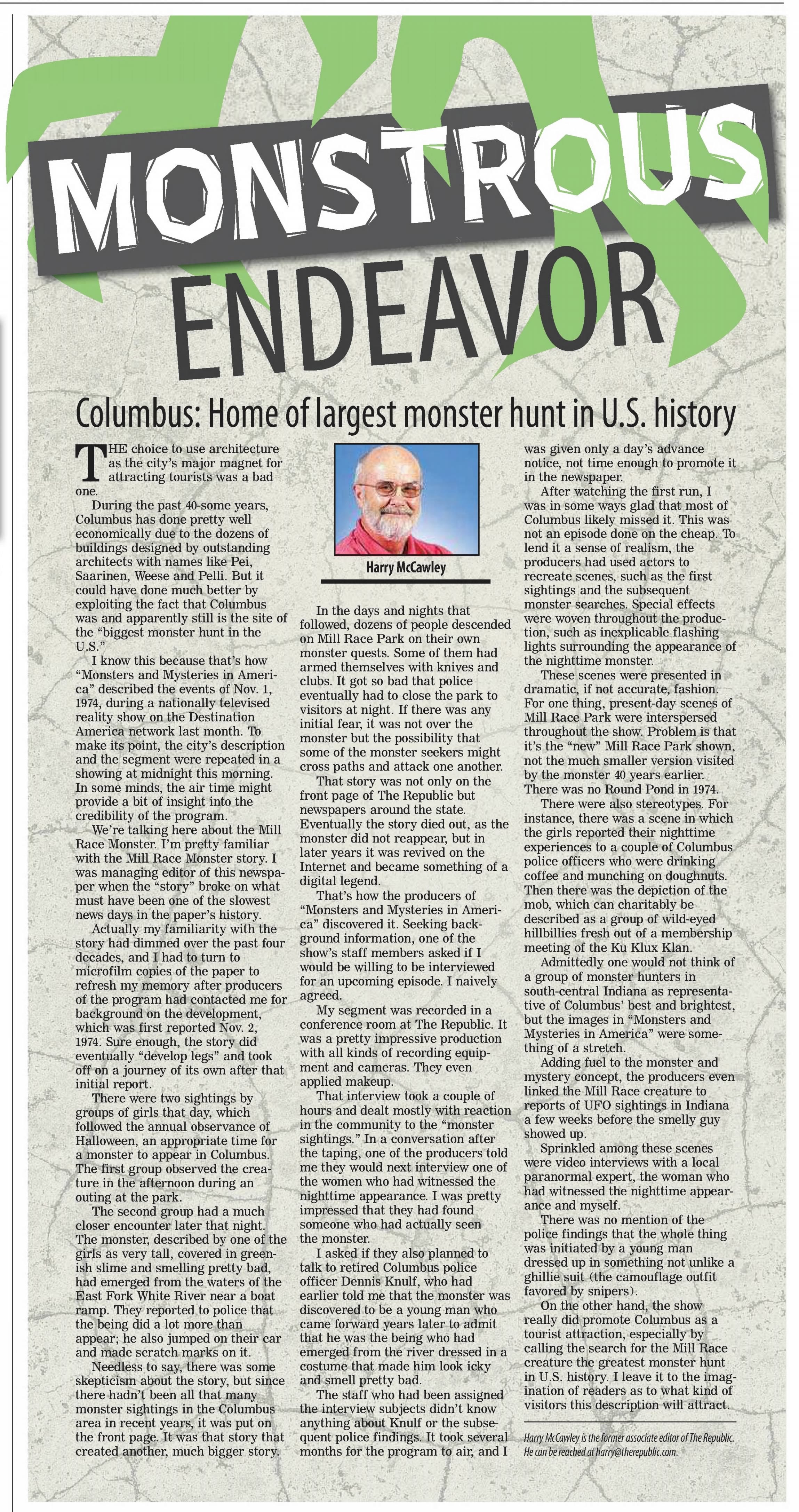
In 2015, Harry returned to his “man in a blanket” theory in a column about a feature on Destination America’s Monsters and Mysteries in America. Harry said Sgt. Dennis Knulf had told him the monster was later discovered to be a young man who came forward years later and admitted he dressed in costume but was never arrested because he indeed never committed any crime. Uh-huh.
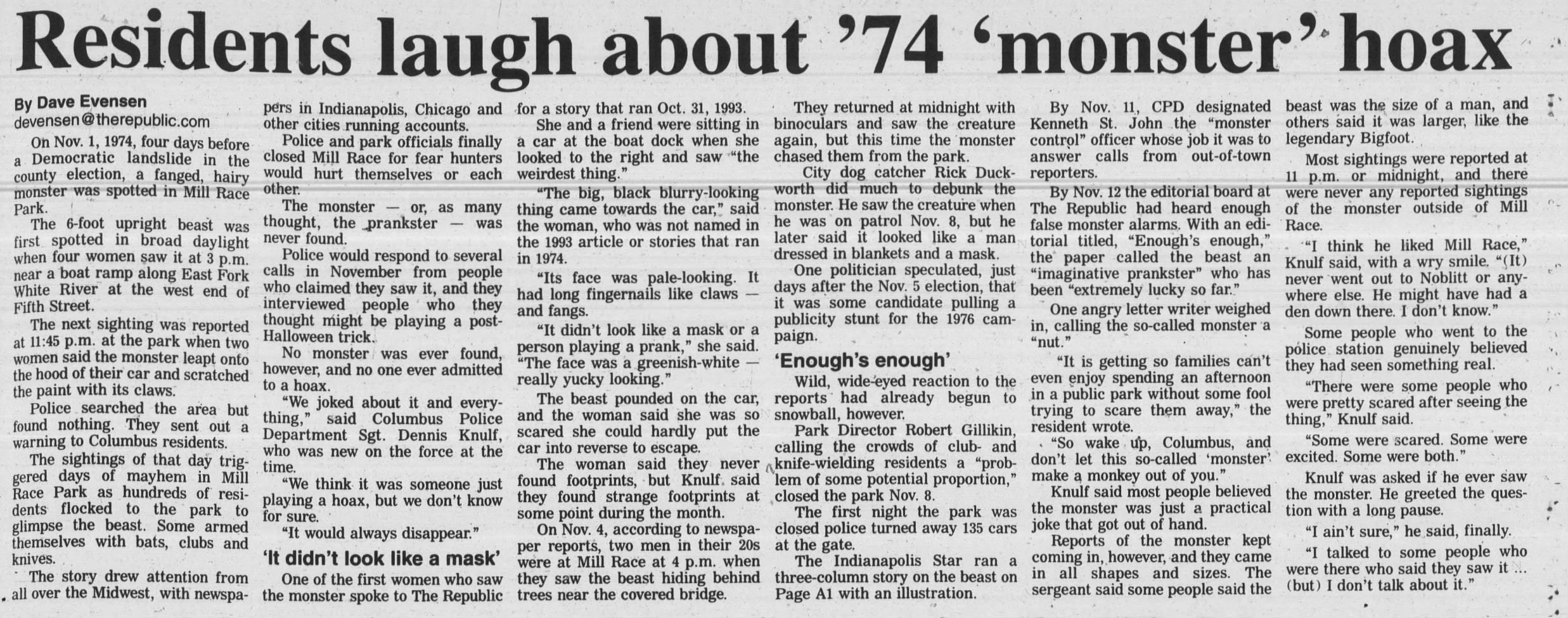
Knulf is the same officer who told Dave Evensen for his October 31, 2003 Republic article, “Residents laugh about ’74 ‘monster’ hoax,” that police thought someone was playing a hoax but didn’t know for sure—and that strange footprints had been found sometime during that November. The same article reported that nobody had ever admitted to a hoax. So who found the footprints? Where were they? Were they measured or photographed? I’d love to know what became of that little detail.
And here’s another wrinkle: McCawley had already published Knulf’s account of an admission in his October 30, 2014 column, before revisiting it in 2015. The admission could have happened after the 2003 article, but the published accounts don’t give us a date, a name, or a clear breakdown of which encounters the person claimed. If somebody admitted wearing a costume, did that include the incident with the car—or are we putting every sighting under one convenient blanket?
Reflecting on the Past
So here we are, almost 50 years later. Let’s revisit what we know now after our crash course in all things Mill Race Monster. First off, as I said before, I was a baby still swaddled up in my drool and poo in November of ’74—so it wasn’t me, unfortunately.
Secondly, the area was a UFO sighting hotspot before the first appearance. Many cryptozoologists and ufologists see a correlation between UFO sightings and encounters with cryptids—Bigfoot, thunderbirds, black panthers, and a whole menagerie of other bizarre creature cases. Usually, these happen in the vicinity of high-energy sources. So you have a lot of instances around power plants, high-tension power lines, radio and broadcast communication towers, railroad tracks, gas lines, military bases, etc. Columbus, Indiana, checks a few of these boxes, especially considering the railroad tracks that follow the river through the park and Camp Atterbury’s proximity. Just sayin’.
Thirdly, I cannot confirm or deny what was behind the Mill Race Monster claims, but several groups reported seeing a hairy green something over those eight days. Was it a cryptid? Maybe? That sounds exciting. Was it a hoax perpetrated by a young man, as city officials claim? Probably. But I do have a few questions. Harry, in his column, quipped that the first sighting happened during the day, which is not normal monster hours. I want to say that if monsters are real, to my knowledge, Harry wasn’t a cryptozoologist who studied the Hairy Green of Mill Race. Plus, globally, there have been countless cryptid sightings during the day. But, if the accounts were valid, I’d like to point out that the ladies who witnessed the monster should’ve been able to discern the difference between flesh and blood versus a 1970s Halloween mask. Have you watched horror movies from that period? Get real.
And what about the face? In a later account, Tyra Cataline described the creature grimacing and trying to bite through the windshield. More elaborate rubber masks were available in 1974, so I can’t say a convincing disguise was impossible. But if she accurately saw the mouth and facial features moving, a simple fixed-face Halloween mask has a lot of explaining to do. What kind of mask or makeup was it? How did it move? And where is the connection between that costume and her encounter? “Some guy in a mask” is an explanation. I’d just like to see it explain the whole damn face.
Cataline also recalled a terrible smell on the outside of the car afterward, comparing it to decomposing animals. McCawley mentioned the reported odor in his March 12, 2015 column, too. So apparently Hairy Green didn’t just leave an impression—he left a stench.
And attacking women and damaging a car by jumping on the hood and leaving scratches are apparently not offenses that’ll get you arrested in Columbus, IN, either—even years later after the alleged man behind the mask came forward—and I don’t advocate testing that theory out.
Skepticism and City Inaction
That’s the part that gets me. People are willing to accept the hoax theory based on the words of the very employees who work for the city that wanted the Mill Race Monster hassle to disappear. In his October 30, 2014 column, McCawley described Duckworth’s sighting as more credible because it came from the city dogcatcher. But The Indianapolis Star identified Duckworth as twenty and Brown as nineteen. If the young women’s ages made their judgment easier to dismiss, why did a city paycheck suddenly make another young man’s interpretation the one that stuck? Twenty is old enough to vote and apparently old enough to become Columbus’ leading expert on people dressed in blankets. It still doesn’t make him infallible.
Even if Duckworth saw exactly what he thought he saw on November 8, what connects that person to the women’s encounters on November 1 or the men’s report on November 5? One person in a costume could explain his sighting. I want to see the bridge that carries that explanation across the rest of the park.
Why did witnesses go to the police station to report a monster instead of saying a weirdo in a costume? And what about the strange footprints left behind? Why would a cop even mention that? When the dog catcher was dispatched to the park, if the monster was close enough to have had those two cats treed, where was it when the call came in? Was it lurking nearby with its dinner bib on, or did it arrive later? Somebody walk me through the fucking cat-rescue timeline. And why wouldn’t law enforcement at least brag a tad that the case was closed if someone came forward later, or at least dropped a hint to the newspaper, even if no arrest was made and that everything was copacetic? Was there a cover-up? Was it the mayor’s son or wife or something? The local priest? The CEO of Cummins Engine Company? It just feels like revisionist history to me.
And who says this has to be an either/or story? Maybe the first witnesses encountered something they couldn’t explain, and somebody in a costume took advantage once the headlines started rolling. Maybe there was a prank from the beginning. Maybe different people saw different things. A later hoax wouldn’t automatically explain the first reports, and an unexplained encounter wouldn’t prevent some local smart-ass from joining the monster business afterward. Columbus may have had a monster, a prankster, or the world’s most poorly coordinated neighborhood watch. Hell, maybe it had more than one.
There’s another reason this story deserves more than an eye roll. The sightings produced police reports, newspaper coverage, frightened witnesses, public debate, and a monster hunt big enough to close a park at night. Whatever anyone believes about Hairy Green, that all belongs to Columbus’ history. A festival gives people a reason to bring out the clippings, share what they remember, and keep asking questions. You don’t have to identify the creature to recognize the story’s value.
So, as I said before, my fourth fact is that Columbus, Indiana, has completely dropped the ball on this. Why? It’s a huge opportunity. How so? I’m glad you asked. Towns are always looking for tourism dollars, and nothing smells more like money to me than celebrating the odd story of The Mill Race Monster. But, the city might have to turn its nostrils down enough to get a whiff of the green cash generated by this beautiful green bastard.
Case in point, let’s turn our attention to Point Pleasant, WV, for the perfect example. You’d have to be living under a rock to not at least have heard about The Mothman. In a quick summary, in mid-November 1966, in that small town of Point Pleasant, two young couples fled the local woods, claiming they’d seen a terrifying creature. They recounted their story to the sheriff and reported that the entity looked human in most respects—except for its 10-foot wings and glowing red eyes. During the next few days, other people reported similar sightings after local newspapers reported it. Two volunteer firemen who saw it said it was a “large bird with red eyes.” Mason County Sheriff George Johnson commented that he believed the sightings were due to an unusually large heron he termed a “shitepoke.” Some intriguing similarities, wouldn’t you say? More city officials were pissing down the backs of the people’s fun, I assume.
Learning from Point Pleasant
But here’s where the two tales go in totally different directions. As the city of Columbus willed its monster into historical absurdity, Point Pleasant hopped on the wings of The Mothman and flew on it. How so? Every year, they celebrate with The Mothman Festival, which draws 10,000–15,000 visitors, pumping money into the local community. They have a statue, they have a museum, and they put on a 5K race—all because of an obscure story that happened that nobody can genuinely prove.
The good news for The Mill Race Monster is that it’s not too late. We can start a Mill Race Monster Festival. We need to change the minds of the city of Columbus and let them see the value of embracing that smelly river ape. Plus, 2024 is the 50th Anniversary of the appearance of Mr. Hairy Green. First, we need a statue. Hell, put it opposite on the intersection facing Eos—our version of Beauty and the Beast, Bartholomew County style!
Planning a Mill Race Monster Festival
Secondly, we need a place to host it: Mill Race Park! Boom! Festival planning comes naturally to me—it’s a gift. A 5K run with participants dressed as the monster? Of course! And lastly, we need the city to plan, approve, and pay for this. Since they took the monster away, they should bring him back. They’d eventually loosen up enough to see the monetary value and the community benefits of having some silly, old-fashioned fun.
Columbus: Embrace the Beast!
Who honestly cares what happened? Let’s party! We can justify it as part of our local heritage. Seymour, Indiana, doesn’t have its own damn monster—not even close. What do they have? Lutherans? Nice try, Seymour. Greensburg, Indiana? Get outta here with your stupid shrub growing out of your courthouse tower. So what? We have a flippin’ monster! Columbus, give us our monster, I say, with my voice of pitchforks and torches! For Columbus to be unexpected, unforgettable—sprinkle it with some unexplainable. I dare you to see what happens.
A Call to Action: Vote for the Monster
As the citizens of Columbus head towards the polls on November 7th, 2023, they’ll be voting for the next mayor. Their choices are either Mary Ferdon, a Republican, or Sean Burton, an Independent. I encourage everyone in the city limits to contact both mayoral candidates NOW, before Election Day, and ask them if they’d support starting an annual Mill Race Monster Festival. If not, I wouldn’t vote for either. It would be better if everyone voted for The Mill Race Monster as a write-in for mayor. Even if the people’s will is defeated this round, if we continue this fight in the ballot box, even if it takes years, Hairy Green will eventually come out on top—with a proper festival. After all, monster stories last forever, no matter if you’ve stopped looking under your beds at night.
Besides, not counting that burgomaster creature of a different hue from a few years back, Columbus has never had an incredibly cool monster in City Hall.
Carpe diem, Columbus, Indiana!
And long live The Mill Race Monster!
— Evel Ogilville
#KeepItMeanWithHairyGreen
#MillRaceMonsterFest
#MoreGreenSpaceLessExplanation
#DontTranquilizeTheCandidate
Timeline:
Mill Race Monster
(also known as (Hairy Green) Monster of Mill Race Park)
Mill Race Park, Columbus, Indiana
November 1, 1974 — The First Reports
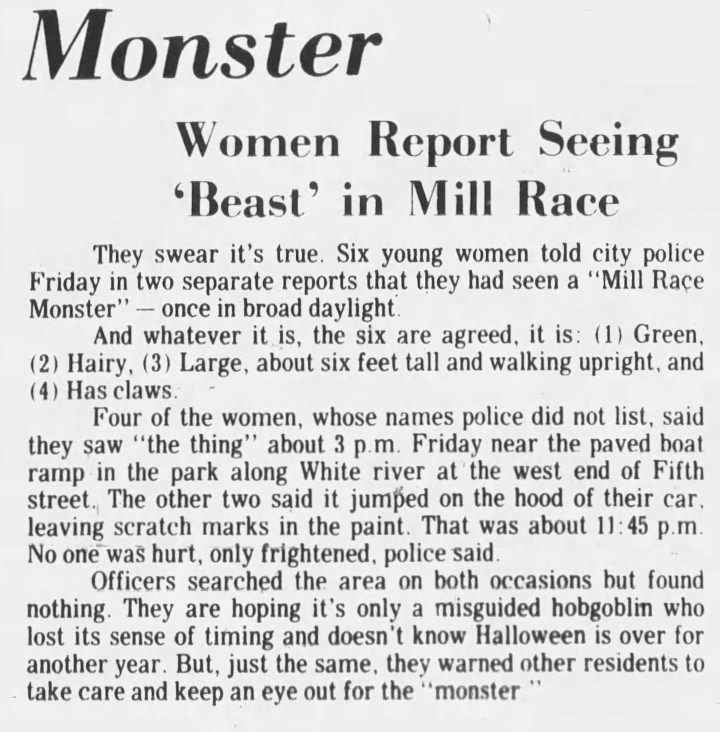
Around 3 p.m.: Four young women reported seeing a strange figure near the paved boat ramp at the west end of Fifth Street along the White River. The description published the next day included a creature that was green, hairy, approximately six feet tall, walking upright, and had claws.
Around 11:45 p.m.: Two other young women reported an encounter in the park. They said a figure jumped onto the hood of their car, leaving scratches in the paint.
Police searched the park after both reports but found nothing. The two encounters were reported before the first newspaper story appeared.
November 2, 1974 — The First Headline
The Republic published “Monster / Women Report Seeing ‘Beast’ in Mill Race.” The article said six young women had made two separate reports: four during the afternoon and two later that night.
The newspaper reported that officers hoped the figure was a misguided hobgoblin that had lost track of Halloween. Even so, residents were advised to take care and watch for the “monster.”
November 5, 1974 — The Covered Bridge
Around 4 p.m., two men in their twenties reported seeing a large, hairy figure near the park’s covered bridge. They returned with binoculars that evening and reported another encounter shortly before midnight. According to their account, the figure chased them out of the park.
One of the men suggested the creature might have been left behind by visitors from another planet. The Republic’s November 6 report connected that speculation to earlier UFO reports in the region.
November 5 was Election Day, and the newspaper headline asked: “Mill Race Monster Makes Appearance After Voting?”
November 7, 1974 — The Hunt Escalates
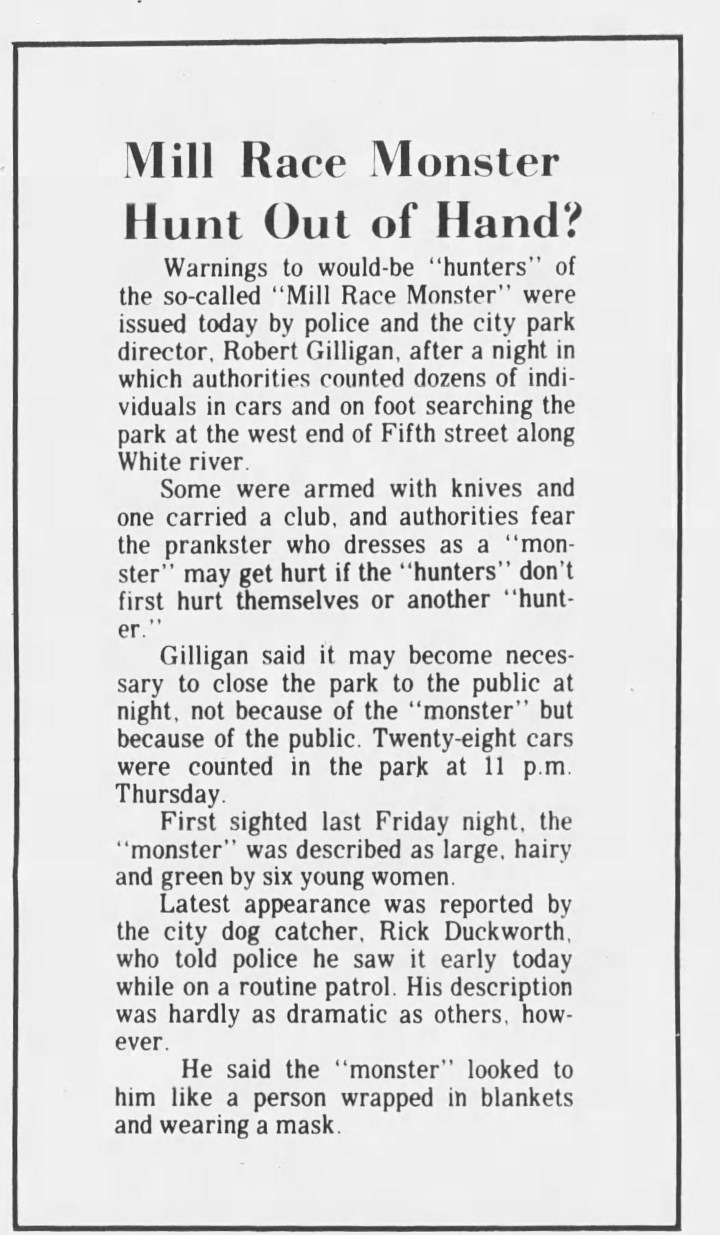
By Thursday night, dozens of people were searching the park on foot and in cars. Authorities counted 28 cars at 11 p.m.
Some searchers carried knives, and one carried a club. Police and park officials warned that a hunter, another person in the park, or someone playing the monster could be hurt.
November 8, 1974 — The Dogcatchers
At approximately 9 a.m., city dogcatchers Rick Duckworth and John Brown reported encountering a figure in the park.
According to the November 9 Indianapolis Star, the men had been dispatched to rescue two cats in a tree. While considering how to reach the cats, they saw a figure about 200 feet away. Duckworth described it as a large man wearing a green mask and wrapped in green blankets, with long reddish hair hanging in its face.
When Duckworth approached, the figure ran into the woods. Duckworth compared its speed to a deer. After the cats were lowered, they ran away, with one reportedly disappearing into a sewer line. Duckworth said the cats were frightened and proposed using the tranquilizer gun he carried for dogs if he encountered the figure again.
The November 8 Republic described Duckworth as having been on routine patrol; the November 9 Star described a cat-rescue dispatch.
November 8–9, 1974 — The Park Is Barricaded
With crowds continuing to gather, parks director Robert Gillikin said the growing number of people searching the park created a danger.
The closure report “‘Green Monster’ No Danger, People Are” says Gillikin counted more than 100 cars in the park on Friday night. The park was closed and barricaded at approximately 1 a.m. during the November 8–9 overnight period, with further nighttime closures planned.
Officials said the purpose was to protect people from one another, including the possibility that armed searchers might hurt someone they believed was playing the monster.
November 11, 1974 — Monster Control
The Republic reported that Mill Race Park remained closed from dusk to dawn. A definite reopening date had not been announced.
Police Officer Kenneth St. John was designated the unofficial “Monster Control Officer,” handling inquiries from newspapers, radio stations, and television stations. The story had attracted attention beyond Columbus.
November 12, 1974 — “Enough’s Enough”
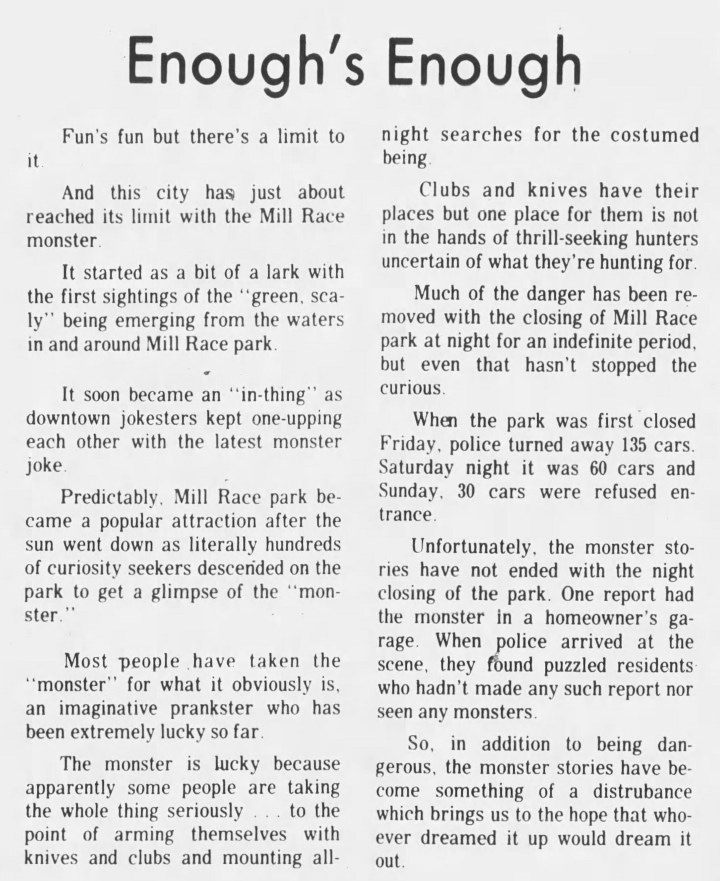
The Republic published an editorial titled “Enough’s Enough,” describing the monster hunt as a dangerous disturbance and the nighttime closure as indefinite.
The editorial reported police turning away 135 cars Friday night, 60 Saturday, and 30 Sunday—about 225 car turnaways across the three nights.
It also described a report that the monster was in a homeowner’s garage. When police arrived, the residents said they had not made the report and had not seen a monster.
November 14, 1974 — A Concerned Reader
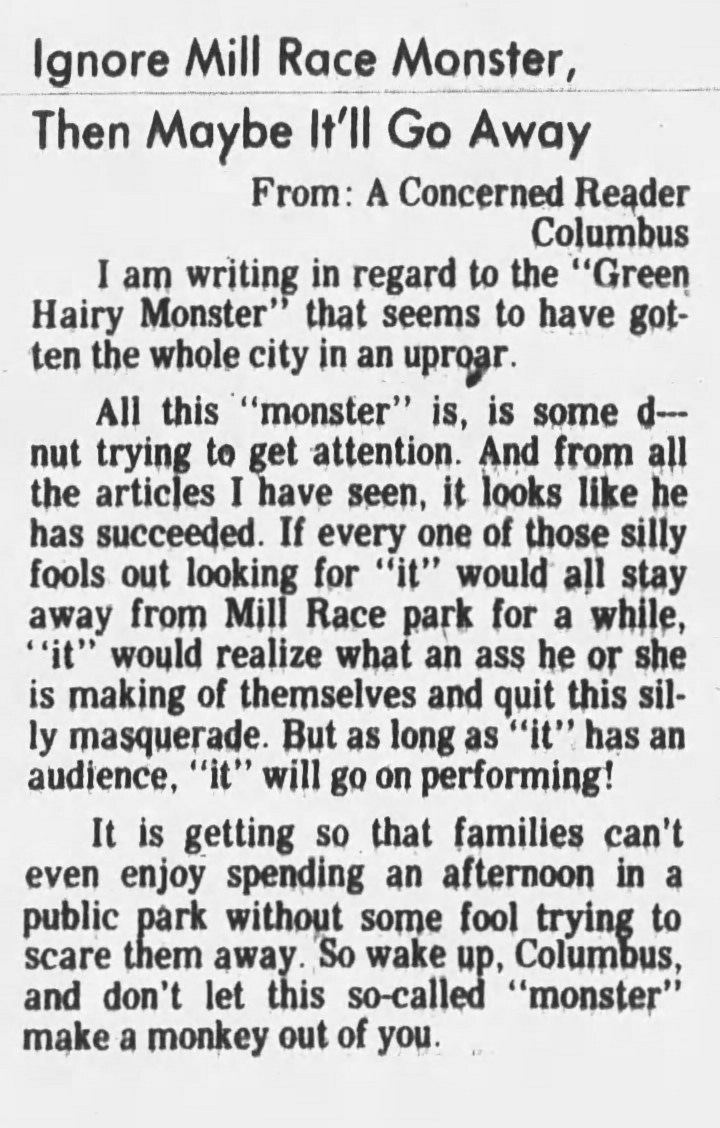
A letter to the editor signed “A Concerned Reader” encouraged the public to ignore the supposed attention-seeker, arguing that the monster would stop performing if the hunters stayed away.
November 20, 1974 — A Monster Roast?
A “Monster Roast” was listed as an item on the Mill Race Park Committee’s agenda. The reference shows how the episode had become material for local humor. Whether a roast actually took place remains to be confirmed from the full clipping.
October 31, 1993 — A Witness Looks Back
In Nancy Wheeler’s Republic article “The monster of Mill Race,” an unnamed woman associated with the nighttime car encounter recalled a frightening figure with a pale or greenish-white face, long fingernails like claws, and fangs. She said it did not look like someone wearing a mask or playing a prank.
The article included an illustration credited to Tyra Cataline.
October 31, 2003 — Strange Footprints
In Dave Evensen’s Republic article “Residents laugh about ’74 ‘monster’ hoax,” Sgt. Dennis Knulf said police thought someone had been playing a hoax, but they did not know for sure.
Evensen reported that the woman said footprints had never been found, while Knulf said strange footprints were found at some point during the month. The article did not describe their size, location, or what became of them.
The 2003 article also said nobody had ever admitted to the hoax.
October 30, 2014 — An Account of an Admission
In “Legend of the Monster Lives On,” Republic columnist Harry McCawley quoted retired officer Dennis Knulf describing a person who had admitted dressing in costume to scare people.
According to Knulf’s account, the person expressed regret. Knulf said no charges were pursued because the person had not really committed a crime.
The column did not publicly name the person, date the admission, or specify which encounters the person admitted staging.
2015 — A Witness’s Later Recollection
In Monsters and Mysteries in America, Tyra Cataline described a frightening car encounter, including a grimacing face, fangs, and the figure apparently trying to bite through the windshield. She also recalled a terrible odor on the outside of the car afterward, comparing it to decomposing animals.
On March 12, 2015, Harry McCawley returned to the story in his Republic column “Monstrous Endeavor: Columbus: Home of largest monster hunt in U.S. history.” He recounted Knulf’s account of an admission and discussed the television program. McCawley also mentioned the bad smell in describing the later witness account.
The original November 2, 1974 brief reported the car-hood contact and scratches; the odor appears in the later accounts identified above.


Sources:
Special thanks to Eunice Specter for her research. And a shoutout to cryptozoologist Chris McDaniel and his book, Spooky Reports of Strange Encounters, for keeping the legend of Hairy Green going.
(The Republic: 11/2/74; 11/6/74; 11/8/74; 11/9/74; 11/11/74; 11/12/74; 11/20/74; 10/31/93; 10/31/03; 10/30/14; 3/12/2015; Indianapolis Star: 11/9/74; 11/10/74)